
The best films of the decade were the films with screenplays that I would have wanted to direct myself. I would be proud to have had any of these films on my filmmaking resume- they deal with subjects that I care about, and they do it masterfully. Each and every one of them, in my opinion.
There were dozens of other films from this decade that I loved. However, I've reduced this list to a minimum of 50. In other words, the 50 films that inspired me the most. But I also have to point out that some titles didn't make the list simply because I haven't seen them yet, or because I'm still unfamiliar with the work of that filmmaker. You may also discover the sad lack of world cinema on the list since I mostly just stuck to American films this decade.
Whatever. My favorites in order of preference coming right up. Or, at least, my top 10 is a definite order of my favorite ten films of the decade in order of preference. After that, 11-50 is ordered rather loosely.

1. Munich (2005)
Steven Spielberg's international thriller about Israel's violent response to the Palestinians following the Black September assault on the 1972 Munich Olympics is the most important film of the decade. Eric Bana gives the first incredible performance of his career as Avner Kaufman, hired personally by Golda Meir (Lynn Cohen) to lead a team of Jewish hit men to find and kill the terrorist agents who plotted the massacre. The team consists of Steve (Daniel Craig), a South African mercenary; Hans (Hanns Zischler), recruited for his ability to forge documents; Robert (Matthieu Kassovitz), a toymaker turned inexperienced bomb maker; and Carl (Ciaran Hinds), the cleanup man. The mission wrecks personal crises on all five of the men, in ways that are best explained by sitting through the film itself. Spielberg and screenwriter Tony Kushner are clearly supportive of Israel, but they are not afraid to criticize right-wing governmental policies (conservative author George Jonas, whose book Vengeance inspired the screenplay, took offense to the film); on that basis you could argue that Spielberg and Kushner's film sets an example for any citizen of any country concerned about how to effectively respond to something as atrocious as terrorism. 2005 was the year in which Spielberg finally dealt directly with the horrors of 9/11: if the flawed but excellent War of the Worlds is all about the attack itself, then Munich is about the spaghettied aftermath. For me, the heart of the film is the scene at the end, in which Avner confronts supervisor Ephraim (Geoffrey Rush) to complain about whether or not eliminating the mission's targets has put an end to the terrorist threat. It is not a film to be forgotten.

2. A.I. Artificial Intelligence (2001)
Stanley Kubrick and Steven Spielberg's breathtaking visualization of the odyssey of David (Haley Joel Osment), the first robot with the ability to love. The film is divided into three acts: the first act, in which David struggles to coexist with his human family, as Monica (Frances O'Connor) assumes the role of his mother, with problematic results; the second act, in which David is banished from his home and journeys with Gigolo Joe (Jude Law) to Rouge City and beyond; and the third act, set thousands of years later, in which David wakes up from the end of human civilization only to be reborn in a world dominated by mechas of an advanced technology. O'Connor is magnificent in her performance as the ashamed mother, whose graceful presence becomes an obsession on the boy's mind- ditto for Law as the player robot framed for murder, and William Hurt as the benevolent Professor Hobby. And Osment's performance as David is the kind of performance that smashes the boundaries of method acting- notice that his eyes do not blink once throughout the picture. From beginning to end, Spielberg remains faithful to the late Kubrick's vision, and the fascinating hybrid of the two filmmakers gives birth to one of the most dazzling cinematic accomplishments of all time.

3. No Country for Old Men (2007)
Joel and Ethan Coen's thrilling, philosophical, even sad, adaptation of Cormac McCarthy's novel, tracking the crazy happenings that come about when Llewellen Moss (Josh Brolin) steals a briefcase from the scene of a drug cartel massacre and takes off with it, pursued by what might as well be described as your average shoulder angels: Ed Tom Bell (Tommy Lee Jones), an aged Texas cop whose voice of reason is failing in a time of violence and despair; and Anton Chigurgh (Javier Bardhem), an unstoppable, gigantic Hispanic armed with a cattle stun gun and an enormous shotgun. Despite the summary, this film is not a conventional chase picture. It is wholly unpredictable, and ends on a note that almost moves me to tears every time.

4. The Lord of the Rings: The Return of the King (2003)
Peter Jackson's majestic conclusion to his adaptations of the J.R.R. Tolkien trilogy. I don't remember the last time I anticipated a film as much as this one; I may never anticipate another film quite like it ever again. As a former student of Tolkien's novels, I was overjoyed when this film began with a prologue of the birthday of Smeagol (Andy Serkis), in which he murders his best friend Deagol in order to take possession of the One Ring, is poisoned by it, forgets his own name and transforms into the creature Gollum over the next five-hundred years; after which he will unwillfully serve as the guide for Frodo (Elijah Wood) and Sam (Sean Astin), the two Hobbits charged with descending into Morder and destroying the Ring in the fires of Mount Doom. It sounds like another silly fantasy adventure, but back when these films came out, I truly believed I was witnessing the evolution of cinema. CGI has never looked better than it has in these films. And though non-readers of the books still complain about the dragged-out ending that stretches over half an hour, I admire every minute of it. Jackson, Fran Walsh and Phillipa Boyens do justice to Tolkien better than anyone ever could have, and the film deserved all 11 of its Academy Award winnings (it should have gotten more, too, in my opinion). It's considered cool to hate on Jackson's accomplishment these days, but I can't help it: I love these films.

5. There Will Be Blood (2007)
Paul Thomas Anderson's brilliant American epic, adapted from Upton Sinclair's novel "Oil!", detailing the rise of Daniel Plainview (Daniel Day-Lewis), who has a competition in him, and wants no one else to succeed. He won't give in to anyone's wishes: not his clients; not his brother (Kevin J. O'Connor); not the local preacher Eli Sunday (Paul Dano); not even his own son, who goes from a reliable business partner to a deafened, juvenile burden. Though it lacks the massive sequences of violence, I actually think this is a more entertaining film than No Country for Old Men, since Day-Lewis' performance (arguably the best male performance of the decade) is just plain titanic. Anderson takes the socialist messages of Sinclair's literary prose and twists it inside out into a fable of capitalism at its meanest.

6. Youth Without Youth (2007)
Francis Ford Coppola's astonishing comeback after a ten-year hiatus is his greatest film in a generation. From the moment the protagonist, Dominic, (Tim Roth) wakes up in bed and tells us in a voiceover, "Sometimes I wonder if I will ever be able to finish my life's work", we're immediately reminded of the musings by Captain Willard in Apocalypse Now. But Coppola's film is not a collection of self-homages: it is one of the most original American films ever directed. It starts out as an international thriller, then becomes a love story like no other. Expertly edited by Walter Murch, the film also moves at a fast pace, and Coppola uses a nonlinear, stream-of-consciousness approach in his handling of the story. After Dominic, a 70-ish year old man, is struck by lightning, he magnificently begins to age backwards into a young man again. Who knew that Coppola could be so wonderously innovative?
7. Mulholland Drive (2001)
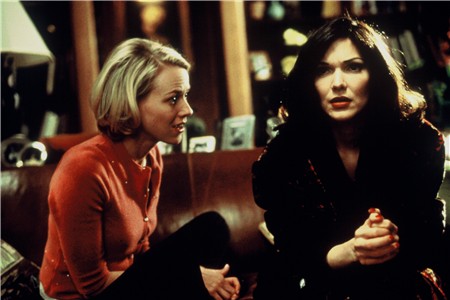
David Lynch's miraculous work of surrealism in Hollywood speaks for itself. So, wait a minute: how exactly do Naomi Watts and Laura Elena Harring end up swapping character roles? And why again does filmmaker Adam Kesher (Justin Teroux) lose control over his dream project... only to suddenly have complete control over it again? Whatever the explanations are, it makes no difference. Lynch has devised a motion picture so endlessly creative that one can see it dozens of times and pick up a different sort of reaction with each viewing.

8. The Pianist (2002)
Roman Polanski's harrowing dramatization of the experiences of Wladyslaw Spzilman, a pianist who escaped certain death in Nazi-occupied Poland not because of skill or wit, but because of mere luck. In his terrific portrayal of Spzilman, Adrien Brody (who won a richly deserved Academy Award for his performance) undergoes a jaw-dropping transformation from well-dressed artist to unshaven street survivor; and Ronald Harwood's screenplay compares to Steve Zaillian's script for Spielberg's Schindler's List as a bitterly truthful document of a terrible time. Polanski, himself a Holocaust survivor whose mother perished in the gas chambers, never turns away from the subject matter. The most haunting shot in the film occurs when Spzilman climbs over the side of a fence: Polanski's camera rises to show Spzilman running into an abandoned city covered in snow, with no clear sanctuary in sight.

9. The Aviator (2004)
Martin Scorsese's biopic on the glory days of Howard Hughes (Leonard DiCaprio) is not your standard biopic. Rather, it is a story about how fame and fortune can be cruelly limited by disease. DiCaprio is surprisingly good as Hughes, but he's surrounded by great co-stars, including a knockout Cate Blanchett as Katherine Hepburn, Alan Alda as the fierce Senator Brewster, Alec Baldwin as the pesky Juan Trippe, and John C. Reilly as Hughes' pressured advisor Noah Dietrich. Scorsese's film is not really a tribute or a criticism of Hughes- or even a straightforward summary of his life. It is, well... something. In the last scene, an unraveling Hughes is locked into a room for the sake of his own sanity. This is Scorsese's way of closing the door on Hughes' glory days- he will, in a sense, be locked in a room for the rest of his life.
-799479.jpg)
10. Redacted (2007)
Brian De Palma's fiery, unflinching critique of the War in Iraq. It is certainly one of the most controversial and divisive films of the decade, and has earned more than one threat against De Palma's status as a filmmaker and as an American. Myself, I consider this the best film on the Iraq War to date. I admire De Palma's original screenplay for its immediacy and its deconstruction of the dishonesty the war was founded upon. Many have criticized the performances of the inexperienced actors; I, on the other hand, give a thumbs-up to De Palma's approach of capturing those feelings of fake behavior as seen in any average home video. To be sure, there is a devastating performance by Rob Devaney as Lawyer McCoy, who is powerless to stop the men of his unit from molesting and slaughtering a 15-year old girl. He then reports the incident, and returns home in tears to a family that assumes he is fighting for a good cause in a country that appears to be worth fighting in. The film is De Palma's most revealing since Hi, Mom! (1970) and his strongest effort since Carlito's Way (1993), and cements his place as one of our bravest living film artists.

11. Minority Report (2002)
Steven Spielberg's terrific futuristic neo-noir headed by Tom Cruise as John Anderton, a Washington D.C. police officer in charge of an advanced security program that uses the visions of psychic Precogs to locate and stop domestic crime before it occurs. Alongside Cruise's powerhouse performance, there is also a swansong performance by Max Von Sydow as Lamar Burgess, the well-intentioned chairman of the program, who attempts to bend and break the law for the sake of the safety of the people, and winds up crippling the justice system. Spielberg made this film in the wake of 9/11 in response to President Bush's USA Patriot Act. However, now that the current administration has problems with its own national security system as seen over the holidays, we may need films like this more than ever right now.

12. Zodiac (2007)
David Fincher's heart-pounding dramatization of the unsuccessful attempts by cops, detectives and outsiders to uncover the identity of the infamous Zodiac killer of San Francisco is the first of Fincher's films that has ever left me gasping for air. Literally. As one who has never been much impressed with Fincher's popular work (I'm no fan of Fight Club and am even less enthusiastic about this decade's The Curious Case of Benjamin Button), I was startled by how much this film excited me and drew me into its atmosphere. First of all, Fincher makes good on his promise to make this film not just convincingly set in the 1970's, but the film itself even feels like it was made in that decade: from the moment we see the classic Paramount and Warner Bros logos, we know we're in for something unabashedly old-fashioned. The film evokes the pleasure one gets when watching an Alan J. Pakula crime picture; and Fincher even at times has his characters stare directly into the camera, a la Jonathan Demme. Yet what gripped me most of all was how much I identified with Jake Gyllenhaal's obsessed cartoonist character- not since Twin Peaks have I so desperately wanted to learn the identity of the murderer.

13. Master and Commander: The Far Side of the World (2003)
Peter Weir's adaptation of the Pat O'Brien novel is as great an epic of the sea as there ever was one. Russell Crowe's performance as Jack Aubrey, the captain of the HMS Surprise, is by far my favorite of any of Crowe's performances; and Paul Bettany mirrors him as the ship's ambitious doctor Stephen Maturin. Weir reduces the number of the battle sequences; this film is not so much about action as it is about life at sea and the tolls it can take on patience and trust. At the heart of the film is the friendship between Aubrey and Maturin, and their political differences: Aubrey is a conservative and seeks to eliminate the enemy at whatever the cost, while Maturin, a liberal, detests authority and champions the virtues of science first and foremost. Oh, and Weir proves that the theory of Darwinian evolution is right after all.

14. The Lord of the Rings: The Fellowship of the Ring (2001)
Peter Jackson's first installment in his trilogy was the first mind-blowing cinematic experience I ever had as a child. Suddenly, I had fallen in love with Middle Earth. I wanted to be just like Ian McKellen's Gandalf and do battle with a Balrog, or get in a wizards' duel with Christopher Lee's Saruman. I wanted to be like Viggo Mortensen's Aragorn and come to the rescue of Sean Bean's Boromir at the last second. I wanted to be like Elijah Wood's Frodo and pull Sean Astin's Sam from beneath the lake. Basically, I wanted to go on that quest, and my wavering dream of becoming a filmmaker was confirmed. I still don't understand how Jackson pulled it off. "So do all who live to see such times..."

15. Kingdom of Heaven: The Director's Cut (2005)
Ridley Scott's best film since Blade Runner is also his single great film of this decade. As far as the rest of his twenty-first century output goes, I think that Gladiator, Black Hawk Down and American Gangster are all entertaining but overrated; while Hannibal, A Good Year and Body of Lies are mildly interesting failures. This film, however, is glorious- depending on which cut you see. The original theatrical cut that the studio pressured Scott to deliver initially is little more than a mediocre action flick. The director's cut, however, fleshes out all of the characters and provides us with a glimpse of the passionate vision that was really on Scott's mind. Thus, Orlando Bloom's Balian is a more likable hero; Liam Neeson's Godfrey is a more understandable father figure; and, most importantly, Eva Greene's Sibylla becomes a three-dimensional character, thanks to a subplot involving her struggles to raise a leper son (a subplot that was not in the theatrical cut). Scott and screenwriter William Monahan present us with the ultimate Crusades epic, one that understands the actual value of what a city like Jerusalem is worth: "Nothing. Everything."

16. Before the Devil Knows You're Dead (2007)
Sidney Lumet's brutal, hard-hitting melodrama, starring Phillip Seymour Hoffman and Ethan Hawke as two of the most repulsive brothers you've ever seen in a film. What starts out as a heist thriller becomes an extremely painful story of the downfall of a normal American family thanks to the misdeeds of the brothers. With the addition of Albert Finney as the brothers' weary old father and Marissa Tomei as the chick who's sleeping with both of them, Lumet gives us a story so vicious, so cold, and so relentlessly nasty that... it's dynamic material. The film has all of the shouting matches of 12 Angry Men, all of the crime devastation of Dog Day Afternoon, all of the satirical elements of Network and all the character flaws of The Verdict. In short, it's the kind of film that Lumet has basically been building up to his whole 85 years of living, and it's nothing short of a powerhouse.

17. Gosford Park (2001)
Robert Altman's whodunit is not so much about the murder at the center of the plot as it is about the first-class people involved in it, and, especially, the lower-class servants who bear witness to the events that follow. All of this is composed in an excellent screenplay by Julian Fellowes, and one wishes he and Altman could have collaborated on more projects. The cast is stellar, but the best performances come by Michael Gough as a pompous beaurecrat who can't keep his hands off his dog; Maggie Smith as his rich, neglected old sister; Helen Mirren as a cold housemaid; and Clive Owen and Ryan Phillipe as male servants who both have mysterious intentions. Sadly, I haven't seen any of Altman's other films from the decade (Dr. T. and the Women, The Company, A Prarie Home Companion), but this one reassures me that he was at his finest hour in the last eight years of his life.

18. Saraband (2005)
Ingmar Bergman's final film is an unofficial sequel to his masterpiece Scenes from A Marriage (1974), bringing back Erland Josephon and Liv Ullmann as Johan and Marianne, who divorced in the earlier film and yet have never been able to break the bonds between them. Bergman's filmmaking remains as towering as ever, and he provides us with tons of memorable sequences: the sudden burst of red that overpowers the frame in the midst of a family brawl; the overhead shot of an abused girl walking across a calm pond and screaming off-camera; and the dreamlike scene of a cello player surrounded by a vast space of white. Through all of the ugly family disputes and the cruelty between father and sons (and fathers and daughters), somehow Bergman's illustration of the relationship between Johan and Marianne is, nevertheless, able to endure. In one scene, Bergman even has both of these elderly people undress for the camera, but reverses the gender politics: Johan undresses in the light, while Marianne undresses in the darkness.

19. Spirited Away (2002)
Hayao Miyazaki's mixture of a little bit of Lewis Carroll and a little bit of Edgar Allan Poe. An adventure, a nightmare, a story of a whiny little girl who learns how to become a better, stronger human being. Many have called it the greatest animated film of all time. Though I don't quite share that exact opinion, I wouldn't try to disagree or anything- as this is most certainly the best animated film of the decade, at the very least.

20. Angels in America (2003)
Mike Nichols' HBO Miniseries adapted by Tony Kushner from his own incomparable play- still the best fictional story ever written about AIDs. Everybody in the cast- Meryl Streep, Ben Shenkman, Patrick Wilson, Mary-Louise Parker, Justin Kirk, Jeffrey Wright, James Cromwell- is excellent, but most of all I love Al Pacino in his portrayal of the nonfictional Roy Cohn, who is dying of AIDs himself in 1980's Reagan-era America; and is failing in the attempt to clear his name as a committed conservative while covering up his past as a gay man. As far as the rest of Nichols' output this decade goes, I admire Closer and don't care for Charlie Wilson's War, but this film is my favorite of his stuff from this decade. It's probably even my favorite of all of his films. Of course, Kushner's prose helps a great deal. And so does Thomas Newman's angelic score.

21. Gangs of New York (2002)
Martin Scorsese's tough-as-nails epic detailing the greed and gore covering a New York City caught in the middle of the Civil War era, flirting with the kind of corruption to be seen eventually in the Gilded Age that would follow. Leonardo DiCaprio and Cameron Diaz are likable as the young leads, but Daniel Day-Lewis' performance as the infamous Bill the Butcher is really what shatters the bones. It is also a tale of revenge, and how vengeance only leads to piles of collateral damage. The one glaring flaw is the superfluous presence of U2 on the soundtrack.

22. King Kong (2005)
Peter Jackson's tribute to Merian C. Cooper is one of the best remakes ever made. Naomi Watts is a fitting successor to Fay Wray (and Jessica Lange), and I even applaud the unorthodox casting of Adrian Brody and Jack Black in the two male action-hero roles. I suppose, though, that the best performance in the film is by Andy Serkis, who follows up on his performance as Smeagol/Gollum in the LOTR films with a digital performance as the mighty Kong. Sure, he only does the movements, but all of that thrashing and chest-beating sure is exciting, isn't it? You gotta love that lengthy fight with the V-Rexes, as well as that icky sequence in which the men find themselves trapped in a giant man-eating-insect infested pit. What matters most, however, is whether or not Kong's relationship with the Watts character gains our affections, and it does.
23. Eastern Promises (2007)
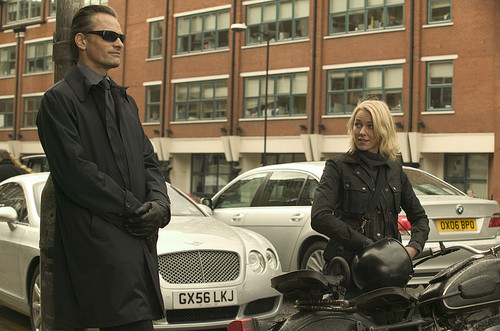
David Cronenberg's visceral, filthy look at the inner-city violence of the Russian mob is a worthy follow-up to A History of Violence. Viggo Mortensen has never been better as the mob's chauffeur, and Naomi Watts gives one of her best performances as the heroine who gets in way over her head- after she takes possession of the baby daughter of one of the mob's rape victims. The great Armin-Muehller Stahl gives a tremendous comeback performance as the don of the mob family, playing him as a seemingly friendly man whose villainous nature takes shape in no time. It's more of a Samuel Fuller-type gangster melodrama than it is a straight-up mob picture. Nice to see such a cinematically-influenced turning point in Cronenberg's career.

24. Punch-Drunk Love (2002)
Paul Thomas Anderson's Godardian, Altman-esque examination of the crumbling misadventures of Barry Egan (a stellar Adam Sandler), whose boring life and aggravating troubles are salvaged with the intervention of the perfect woman (an equally stellar Emily Watson) whose love proves to be the greatest medicine of all. Anderson literally tells the whole story with his camera, infusing long takes with dreamlike scene transitions to result in a cinematic experience that is purely intoxicating.
25. Finding Nemo (2003)
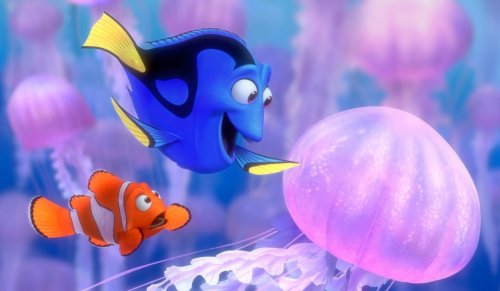
Andrew Stanton's seductive fish tale is Pixar's most satisfying achievement of the last ten years. Sure, the plot is the same-old, same-old: it's another story about a quest to find and rescue somebody, which is not unlike countless other Disney films before it (not to mention John Lasseter's own Toy Story 2). Yet this film does as remarkable a job as any of putting a unique twist on conventionalism so that the film looks and feels so, so new. The voice talents by Albert Brooks, Ellen DeGeneres and Willem Dafoe are expectedly charming, but what I adore most of all is the animation of the ocean, the coral reefs, and the entire enviornment surrounding Sydney, Australia and beyond. Stanton's Wall-E is another great film from this decade- though I still prefer this film, in terms of visual appearance. Not even James Cameron's films seems to have as much appreciation for the wonders of the deep as this film does. And, again, another angelic musical score by Thomas Newman.

26. Letters from Iwo Jima (2006)
Clint Eastwood's powerful examination of the Japanese point of view during World War II, and a truthful depiction of the Japanese code of honor at the time. Such scenes as the soldiers comitting suicide, one by one- just moments before defeat- introduce us to the side of the war that we're not used to seeing in the other films. Unusually, Eastwood, a Libertarian in real life, is also not afraid to demonize American troops, as he does in a scene where U.S. soldiers murder an unarmed Japanese P.O.W. There is a marvelous performance by Ken Watanabe as a general who holds no grudges against the Americans (indeed, we see him in a flashback joyously chatting with some Americans at a dinner table), but is nevertheless willing to die for his country. Though I admire Mystic River and Million Dollar Baby (and cannot stand Space Cowboys), this is the only Eastwood film from the decade that I admire tremendously.

27. City of God (2003)
Fernando Meirelles' innovative film about the gangs of Rio de Janeiro, in which boys become members of the mob often at incredibly young ages. Most, like L'il Ze (Leandro Firmino da Hora), turn predictably to lives of murderous crime. However, Meirelles is more interested in the story of Rocket (Alexandre Rodrigues), who somehow is able to find a life out of this hellish underworld thanks to the miracle of photography. No wonder Robert Altman was a fan of this film.

28. Grizzly Man (2005)
Werner Herzog's eye-opening account of the tragic story of Tim Treadwell, the impassioned environmentalist who, after failing to get cast in Woody Harrelson's role on Cheers, turned to a life of activism for wild bears, became so obsessed that he reached the point of wanting to become a bear himself, and ended up being killed and eaten- along with his alienated girlfriend- by a bear that evidently wasn't charmed by his constant interferences with nature. Herzog grants us access to many of Treadwell's video diaries, and we get a laugh out of footage of Treadwell going on an obscene tirade against all the government officials trying to set limits on his prospects. But Herzog makes sure to underline a strong point: that Treadwell's inability to cope with the fact that all creatures abide by a "survival of the fittest" code is what led to his demise.

29. The Departed (2006)
Martin Scorsese's return to the gritty streets and the dealings of the gangs that lurk there has been lampooned in recent times as overrated, largely due to the fact that Scorsese had already been thought to have moved on from this genre. Still, I cherish every single minute of this film, which is thoroughly suspensful and entertaining despite the whacky William Monahan screenplay. Say what you will about the cast: I think that DiCaprio, Nicholson, Damon, Baldwin, Winstone, Wahlberg, Sheen and Vera Farmiga are all top-notch (and who else but Scorsese could assemble such an awesome team of actors?). I like to think of the film as Scorsese's own Touch of Evil- it's like a masterful B movie. Maybe the upcoming Shutter Island will be his The Trial.

30. Ratatouille (2007)
Brad Bird's perky celebration of cooking is the most original film Pixar has ever released. Who knew an animated film about food could be so amazing? It's got the adult wit of Bird's The Incredibles, but it's actually a superior film because Bird retains a little bit of that childlike point of view he used with 1999's The Iron Giant as well. Along with that, there are some nice camera and crane shots that feel like they've come right out of Hitchcock or Welles. Or De Palma.
31. Road to Perdition (2002)
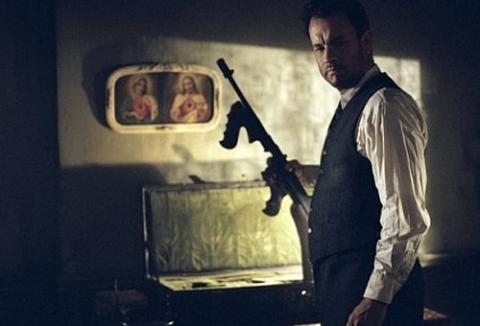
Sam Mendes' absorbing gangster tale is rather Oedipus Rexian in its structure, which is why I cherish it so. Tom Hanks takes upon the antiheroic role of Michael Sullivan, a hitman who is forced to flee with his young son after the rest of his family is slaughtered by order of his own mentor, John Rooney (Paul Newman in one of his last great performances). In some ways this is the Spielbergian mob movie that Spielberg never directed- as Mendes casts future Spielberg stars (Hanks, Jude Law, Daniel Craig, Stanley Tucci) in many of the key roles, and also employs familiar Spielbergian elements like a touching musical score (by Thomas Newman) and expert cinematography (by the late Conrad Hall); not to mention he tells a heartwarming story about the struggling bond between a father and son. I should probably also voice the admiration I have for Mendes' Revolutionary Road, another film from this decade about an American Dream that graphically dissolves in front of the very eyes of the family that tries to live it.

32. The Lives of Others (2006)
Florian Henckel Von Donnersmarck's remarkable study of Communist East Germany during the pre-Gorbachev days in the 1980's, when the Secret Police wired the apartments of all suspected individuals. For fear of giving away this film's important plot secrets, I will say no more.

33. Cast Away (2000)
Robert Zemeckis' marvelous survival picture, starring Tom Hanks in perhaps the bravest performance of his career as Chuck Nolan, whose FedEx plane crashes in the ocean and who spends the next 4 years building fires, talking to a volleyball, splitting his hand open, slicing out an infectious tooth, and so on. I admire this film because of Zemeckis' audacity to revive the days of D.W. Griffith- he comes about as close as any filmmaker ever has in the last twenty years in giving us a silent epic. Still, there's more to the film than just the survival elements. When Nolan returns home, only to find that his girlfriend (Helen Hunt) is now married with children, he is forced to deal with another type of survival.

34. The Lord of the Rings: The Two Towers (2002)
Peter Jackson's second installment in the LOTR trilogy is unquestionably the darkest and nastiest of the three films. I thought long and hard about keeping it off this list, since I wondered if it holds up as an individual film as well as the two climatic films that bookend it. Then I watched it again recently, and realized that it most certainly does: where the first film was about discovery and personal obligation, this subsequent film is summarized in the words of Sam: "...there's some good in this world, Mr. Frodo. And it's worth fighting for." From what I hear, screenwriters Fran Walsh and Phillipa Boyens invented that line on the spot, and it is a stroke of genius. It justifies the need for this film to exist before moving on to the overwhelming extremities of the third film.

35. Bug (2007)
William Friedkin's grueling adaptation of Tracy Letts' play, starring Michael Shannon as a peculiar man who walks into the life of a redneck woman (Ashley Judd) and turns her world upside-down. It's a gritty, disturbing film about paranoia, human agitation, and conspiracy theories- and Shannon and Judd's performances are so extraordinary, they almost seem impossible. A strong comeback for Friedkin, who combines the fast-paced energy of his The French Connection and the nightmarish horrors of his The Exorcist to result in something so wrenching, it's scary.

36. No Direction Home: Bob Dylan (2005)
Martin Scorsese's four-hour documentary was the film that opened up my appreciation for Dylan's music. We see his pretentious, self-absorbed side and his poetic side, and as a result we're able to formulate some sort of final opinion on him, ambiguities and all. What's more, it's refreshing to hear Joan Baez' side of the story, as she gushes about her "discovery" of Dylan before he became famous, only to seethe in anger about his refusal to allow her to sing with him on tour. Combine it all and you'll be screaming for Scorsese to make a sequel detailing Dylan's life after the 1960's (this film stops at 1966).

37. Perfume: The Story of A Murderer (2006)
Tom Twyker's romantic, shadowy serial killer picture is the most absorbing of its kind since Kubrick's A Clockwork Orange. Twyker, like Fernando Meirelles, is a master of fast cuts and handheld camerawork. At the same time, he uses widescreen to an exotic effect, at times evoking the films of Milos Foreman in his illustration of an 18th-France plagued by a serial killer with a fetish for the scent of female virgins. Dustin Hoffman and Alan Rickman are superb as always as two professional men unlucky enough to cross paths with the young killer.

38. Catch Me if You Can (2002)
Steven Spielberg's first collaboration with Leonardo DiCaprio and second collaboration with Tom Hanks. As he did with Minority Report (and would also do later with the underrated The Terminal), Spielberg poses questions about America's national security system and how exactly we are supposed to deal with domestic criminals running around the country. Only, this time, Spielberg does what he did earlier with his career in The Sugarland Express (1974), and actually takes the point of view of the criminal himself, in a more personal attempt to see what went wrong. Spielberg and screenwriter Jeff Nathanson only go so far as to suggest that divorce and family issues were what drove DiCaprio's Frank Abagnale away from home and into a life of check forging, and they go no further- a wise decision, if I may add. It's one of Spielberg's funniest films, but also in some ways the most effective response to his own childhood: the scene in which Abagnale reunites with his weak father (Christopher Walken, never better) evokes Spielberg's relationship with his father, WWII veteran Arnold Spielberg. Until this film, the conflicts of their real-life relationship never felt so present.

39. The Proposition (2006)
John Hillcoat's resurrection of the Western genre is a dark, violent story that preaches an antiviolent message. It's my favorite kind of Western, and one that John Huston and Sam Peckinpah would no doubt be proud of. Guy Pearce plays Charlie Burns, a gunslinger who is forced to find and kill his escaped convict brother, Arthur Burns (a badass Danny Huston, obviously channeling his late father) in order to spring his other brother from jail and execution. The supporting cast is irresistable: Ray Winstone, Emily Watson, David Wenham, and a wild-eyed John Hurt- how can you say no to that? Hillcoat's other film from this decade- the adaptation of Cormac McCarthy's The Road- is another highly recommended antiviolent film set in a country overrun by terrifying carnage.

40. Sideways (2004)
Alexander Payne's refreshing romantic comedy is, to quote Owen Gleiberman, the best of its kind since Annie Hall. Before I saw the film, I read the novel by Rex Pickett, which I found mediocre and ridiculously over-the-top. Payne and Jim Taylor, however, make it more realistic and true. Not only do they really bring Paul Giamatti's Miles and Thomas Hayden Church's Jack to life as living, breathing, wine-drinking men, but they make an even greater change with Virginia Madsen's Maya, giving her a monologue about her interpretation of a bottle of wine as "alive" that takes the film to a different level entirely. It's a decidedly more optimistic film than Payne and Taylor's previous work- the excellent Jack Nicholson vehicle About Schmidt (and obviously a more fully realized vision than their hammy screenplay for Joe Johnston's Jurassic Park III)- but like many of this decade's finest comedies, it also has a darker edge to some of its humor. On the downside, the film appears to have seriously hurt the Merlot industry!
You know what? I feel like I've grown fifty years older just typing all of this, actually.


