Saturday, May 29, 2010

Wise Blood (1979)


On the day he returns home from the war, Hazel Motes is so eager to shed the skins of his past that he throws away his Army uniform in a general store trash can. When he arrives at the doorstep of the homestead he once lived in, there are no friends or family members waiting for him--and the only thing inside that he thinks is still worth killing for is a creaky old chifferobe. Nobody lives out in the country anymore: everybody has long since taken the interstate out into the city. Nothing left out here, really, except failing Bible Belt institutions that have little more to offer townsfolk, other than to spread the Christian word. Each and every road sign and small business is still advertising for Christianity in one way or another--even the local Dairy Queen.

It is the America that Flannery O'Connor presented to us in her 1952 novel Wise Blood, and it burns devilishly (and comically) in John Huston's masterful 1979 film adaptation. Hazel Motes, as portrayed by Brad Dourif in one of the last great performances of the 1970's, has reached the sort of midlife crisis that all men who live in the Bible Belt must dread: he has lost his faith. In God, in Jesus, and especially in his fellow man--he talks again and again of starting up his own church, and yet he is the most resistant soul on the face of the Earth. He scares off a kid who offers him friendship, and viciously bites back when a fellow preacher offers him business partnership. We are not surprised, then, when his church never acquires a single follower, when his only two "relationships" with women are dismal failures, and when his utter contempt for people does nothing but rub onto others. When he is pulled over by a cop on the highway, it is not because of his driving or even because of the poor condition of his car but because, in the cop's own words, "I just don't like your face."

All of the people in this movie are losers. They are not people you would want to know in real life: they are fakes, racists, opportunists, eccentrics and blowhards. Some of them are lonely souls who sincerely don't want to be these kinds of people at all; it's just that by not having control over their environments, their environments have taken control over them. In his 1972 classic Fat City, Huston cast Stacey Keach and Jeff Bridges as small-town boxers with parallel stories: Keach was the aging boxer struggling for a big comeback, and Bridges was the teenage boxer who ultimately gave up his career to live life as a young family man. In Wise Blood, Huston again tells parallel stories, and contrasts Hazel Mote's story with the story of Enoch Emory (Dan Shor), an eighteen-year old who pretends to be an all-knowing holy prophet when, deep down, he is scared, lonely, and in terrible need of a friend. By the time the film is over, these two men will be so disillusioned with societal rejection that they will both try to transform themselves into unnatural creatures: one man will blind and maim himself in an attempt to achieve a martyr status, while the other man will flee from the world by retreating into the miserable confines of a gorilla costume.

Hazel does not start out in Wise Blood as an overzealous preacher; in fact, his transition to this role sort of happens by accident. When he boards a train and sets out for the city of Taulkinham, he is unsure of what he will find there, but he is hopeful for the chance to finally make something of his life--apparently the war did not do this for him. "I'm gonna do some things I ain't never done before!" he excitedly tells strangers. But even before he reaches the city Hazel has already committed his first big mistake: his new, black hat is the kind of hat that only a preacher would wear. He takes offense when a taxi driver asks him if he is a preacher, and he and the taxi driver get into one of those pointless religious arguments that leads to nowhere constructive. "There ain't but one thing for you to understand," Hazel barks, "and it's that I don't believe in anything."

Alas, Taulkinham is no different from any other city in the Bible Belt. The traffic cop gives pedestrians long, politically correct lectures about how they should obey red lights. The landlady (Mary Nell Santacroce) is prejudiced against Catholicism and other "foreign" religions, and only rents out a room for Hazel on the condition that he is a Protestant. The blind preacher Asa Hawks (Harry Dean Stanton, in the same year he appeared in Alien), who peddles the streets, is not even blind--that's just his way of getting attention. Hazel becomes a bit obsessed with Hawks and his oddball daughter Sabbath (Amy Wright), and intensely challenges their perspective of Christianity, to which Hawks reacts with hilarious disgust ("now, you listen to me, boy: Jesus is a FACT!"), and to which Sabbath reacts with swoon. She has never seen a younger man question her father like this before, and gets dreamy-eyed. "I'm just crazy about him!" she squeals in private. "I never seen a boy I liked the looks of any better!" While outside, Hazel is beginning a new church (free of charge) on the streets, right on top of the hood of his car. It will be called the Church of the Truth Without Jesus Christ Crucified.

And of course, there's Enoch Emory, who is thrilled to see somebody like Hazel rebelling against the religious norms of the city, only to discover just how aggressive of a man Hazel really is. Watch the scenes between Hazel and Enoch carefully--particularly their first scenes together. Huston speedily tracks his camera along the sidewalks, frantically making sure to keep up with the two characters as Enoch bores Hazel out of his mind with his life story: "My daddy made me come!" he whines. "I ain't but 18 years old, and he made me come here! And I don't know nobody, and nobody will have nothing to do with me! They ain't friendly!" Hazel tries to make Enoch go away, which only prompts Enoch to observe of Hazel that "you ain't from here, but you ain't friendly, either! And you don't know nobody, either!" It is also interesting that Enoch claims to work at the local zoo, and yet he behaves at the zoo like a true juvenile: he makes faces, insults the monkeys, and doesn't even wear a uniform. For all we know, Enoch doesn't work at the zoo at all.

Obviously these characters are not Hazel's idea of intelligent people--but that doesn't excuse his mean-spirited reactions towards them. There is a painful scene in which he explodes at Enoch for failing to know where Asa and Sabbath Hawks live: in a rage, he grabs Enoch by the coat, shakes him, screams at him, calls him a liar, and throws him on the ground. Does Hazel not even consider that Enoch is just trying to make a good impression? That all he wants to do is be his friend, and that he wants to help Hazel in any way he can? Hazel is equally unkind to Sabbath, who tries to make a pass at him during a walk in the woods--and Hazel responds by running off and driving away without her. And where Enoch and Sabbath both take extreme fascination in a doll-sized mummy from the museum, Hazel looks at it with indifference and, later, repulsion. After they give it to him as a possible "new Jesus" mascot for his church, not only does he refuse it, but he smashes it against the wall and tosses it out the window.

Much of these descriptions probably make Wise Blood sound like a depressingly angst independent film, but it is not. The film has several moments of comedy, not just to give the audience a break from some of the story's more angrier elements but also because--as Huston no doubt must have understood at some point--the humor helps make the portrayals of the Deep South civilians look a little less patronizing. Take, as an example, Enoch's theft of the doll-sized mummy from the museum, which is not treated like a suspenseful heist (like something out of, say, Huston's own The Asphalt Jungle), but is instead filmed with absolute wit and absurdity, like something out of the silent comedy era. Or when Sabbath attempts to seduce Hazel in a Mary Magdalene fashion by writhing around in leaves while telling of a supposedly cursed baby ("nobody cared if it lived or died") that drove its grandmother to suicide; Amy Wright is exceedingly funny in this scene and, what's more, sexy. Or the scene in which Enoch sneaks into a "Gonga" truck and Huston's camera cleverly follows the truck on the road in an unbroken, 30-second take--before Enoch emerges from the back of the truck in the Gonga costume.

Hazel may in fact be the only character in the film lacking a sense of humor. He's got a serious church to run, after all. In one of the film's most memorable bits of dialogue, he preaches to pedestrians: "Where you come from, is... gone. Where you thought you were going to... weren't never there. And where you are, ain't no good... unless you can get away from it." But this speech is interrupted by the nearby sermons of Hoover Shoates (Ned Beatty), a religion profiteer who is literally ripping off Hazel's church concepts for his own church; the only difference being that Hoover does not take these concepts seriously and is only in it for the money, which he gains by charging each of his followers a dollar. And as opposed to Hazel's church, Hoover's church is entertaining, complete with guitar music and a poor man (William Hickey) who is paid to stand on top of Hoover's car and recite raspy, lively sermons.

The poor man is only doing this because he has no other way to make a living, but Hazel is too bitter to understand this, and it results in the film's saddest sequence: in which Hazel tailgates the poor man at night, wrecks his car, forces the man to take off his preacher clothes, and then murders him. William Hickey, who would later play the mafia don in Huston's Prizzi's Honor (1985), has a truly harrowing death scene here in which, as he is dying on the road, all he can do is muster up regrets about the ways he treated his parents. He begs Hazel for help. But Hazel is too full of hate in his heart at this point, and he just leaves the man to die. There are a lot of scenes in Wise Blood that amaze me and make me laugh, but this is the only scene that makes me feel like crying. Hickey's performance here could very well be the single most unforgettable supporting performance in the film.

The score by Alex North is jovial and very much in tune with the song of the South. The screenplay by Benedict and Michael Fitzgerald is said to be very faithful to the original O'Connor novel (unread by me), perhaps because of the helpful input by the film's costume designer Sally Fitzgerald, who was more familiar with O'Connor's material than anyone else working on the production. Huston directed the film during a turning point in his life when he realized that old age was starting to catch up with him. He was forced to sell his Irish estate St. Clerens because of his inability to keep venturing on fox hunts, had moved to Mexico, and had been suffering multiple near-death experiences.

It's strange, then, to see how effortlessly creative a film like Wise Blood still is. Incorrect spelling is one of the film's common themes: Enoch thinks that "museum" is pronounced "muv-se-vum"; the gravestone of Hazel's deceased mother reads that she has gone to become an "angle"; and Huston''s first name is billed as "Jhon" in the beginning credits. And Huston cast real, unprofessional civilians in some of the key roles; hence, the prostitute really was a prostitute, the car dealer really was a car dealer, the highway cop really was a highway cop, and the homeless people really were homeless. As he did in most of his films, Huston also cast himself--he appears in flashbacks as Hazel's grandfather. In one of the flashbacks, a young Hazel witnesses the sight of "Miss Eve" and is so confused by feelings of arousal that he urinates in front of one of his grandfather's Jonathan Edwards-type sermons.

Like Humphrey Bogart's Frank McCloud in Key Largo (1948), Wise Blood is about a veteran who returns home from the war and has no family waiting for him. There is another Huston film, however, that Wise Blood acts as something of a variation on: his banned World War II documentary. The beginning and ending of Wise Blood, as suggested by Huston scholar Lesley Brill, is sort of a reversal of the bookending sequences of Let There Be Light (1946), which began with soldiers who were in traumatized shape, and ended with them making a healthy recovery. Wise Blood begins with Hazel as a healthy veteran, and ends with him in traumatized shape. Fed up with being dissatisfied with the reception received by his church (and other churches), he exhausts all other options and blinds himself with lime oil, wraps himself with chicken wire and punctures his feet with stones. It is during these ending scenes when we can sense that Hazel is starting to transcend, and is actually beginning to grasp the full meaning of his religious evolution.

There was a big disagreement between Huston and Brad Dourif over the ending. Huston wanted to write in an additional scene in which Hazel quarrels with his landlady over matters of rent payment--to which Dourif strongly objected. "No one will care about money at this point in the movie," Dourif remembers telling Huston, in an interview on the Criterion DVD. "The third act is all about Hazel Motes' turn, and his movement towards his commitment to be this saint--to really, absolutely devote himself to this idea of God." I think Dourif was correct, and I am personally glad that Huston cut the scene out. The ending of Wise Blood, as it stands, is one of the most powerful endings I can imagine in a film, precisely because Hazel is not the same man he was at the very beginning. For once he is going where none of his other religious counterparts have gone before.

And at the same time, there is the understanding that despite Hazel's transcending, he can't go on living life this way. Death seems to be the only thing that could bring him to peace. When trapped up in his bedroom with his landlady talking his ear off, he is essentially still being distracted by forces that would choose to compromise his religious transcending. It's no coincidence that there is no fire escape outside his window--there is no escape from the fires of hell. The landlady echoes Sabbath's earlier speech about the cursed baby by reminding Hazel that "nobody cares if you live or die but me!" She feels shut out by his solitary religious practices: "Unless you take what's offered to you, you'll find yourself out in the cold, pitch black! And just how far you think you'll get?" To me this line sounds an awful lot like a ghost of that famous line in Fat City, when Keach mutters to Bridges that "before you can get rolling, your life makes a beeline for the drain". For Hazel and the other characters in Wise Blood, religion offers one way out of the drain. But Hazel is the only one who takes the concept literally--everyone else looks at it in terms of money, and living the American Dream. All except for Enoch, who, last we see him, is running around in the stolen Gonga gorilla costume and reaps nothing from it except perpetual unhappiness. "I only wanted to shake hands," he says to himself in sadness, when people are frightened by his costume.

Howard Hawks once said that he was only interested in making movies about people who were good, and who were professional--he hated losers, and paid no attention to them. Huston, in effect, made films about losers. The Misfits was probably the first film in which he paid a close eye to such characters, and a decade later, Fat City revived this technique just as splendidly. But Huston was also an atheist, which made his choice of directing Wise Blood not entirely as natural as his decision to direct those first two films (though Benedict Fitzgerald's contributions to the screenplay are not so surprising, since Fitzgerald later went on to pen Gibson's The Passion of the Christ). And Wise Blood definitely is not the same sort of project as Huston's other great pictures (The Maltese Falcon, The Treasure of the Sierra Madre, The African Queen, Beat the Devil, The Man Who Would Be King), which are glorious entertainments.

No, I think Wise Blood, like The Misfits and Fat City, forays the harsher worldview that Huston would occasionally return to during his career. Even though he did not share the exact religious views of Hazel Motes, there is no question that he was in agreement with him that Christianity as a whole had regressed into a gross form of advertising. Even today, it is still represented by preachers who capitalize on Christ's words and blatantly disregard simple Christian teachings like caring for the sick and the poor. With that being said, Wise Blood is not asking us to like or sympathize with Hazel Motes: he is a bully, a narcissist, and a murderer. But the one thing he is not is a fraud. He knows that the only true way to find God is through one's own self. It doesn't involve charging people money to hear God's words. And although he pursues this goal in a manner that is extreme and could very well lead to nowhere in the end, Hazel at long last is courageous enough to give his whole life up for God--something that nobody else in Taulkinham is willing to do. Not bad for a man who didn't believe in anything.

Thursday, April 29, 2010

Paul Verhoeven To Direct The Last Express?


Can it be true?

Paul Verhoeven was recently interviewed by MTV about his next project. Verhoeven told them,

"I am working on a movie now that is... situated in 1914. Basically, Indiana Jones-ish you could say, but also Hitchcockian... we are scripting it. It's an idea that exists already... from another medium, and so we are making it now into a film narrative."

Then Verhoeven was asked what medium he was scripting the project from. "A game, a video game".

Of course, he wouldn't say what the game was. "The writer of the video game has asked me to keep [the identity of the game] secret until he has a script."


If I had read this interview back when it was first conducted, I would have known right away which game it was, and who the writer of the game is. But SlashFilm writer Peter Sciretta and Screenrant writer Sandy Schaefer already beat me to it. DAMN! But that doesn't damper the great news. If what we are to believe is true, Jordan Mechner's The Last Express (1997), my favorite computer game of all time, is finally going to be getting a film adaptation.

I have been waiting for this for years. I first played The Last Express in late 2000, when I was in fourth grade. My parents had just returned from a cruise and had bought the game for me after they saw a quote on the cover box comparing the game to Hitchcock. I didn't officially beat the game until well into my middle school days (thanks, admittedly, to online walkthroughs; the game is so difficult!), but I immediately began daydreaming about possibilities for a film adaptation. Last year I even began foolishly writing my own 200-page screenplay adaptation, and sent it to Jordan Mechner (I don't expect it to fall in Verhoeven's hands, sadly).


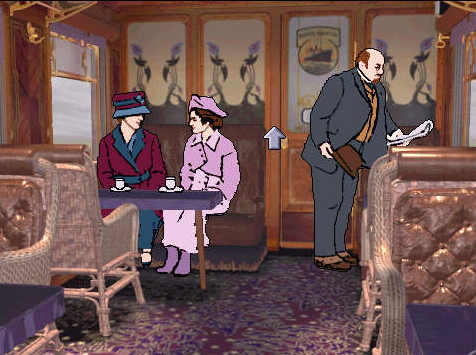
But what IS The Last Express, you ask? It's an adventure game, set in Europe on the brink of World War I, onboard the Orient Express as it travels from Paris to Constantinople. The main character (the guy in the green coat, in the above picture) is Robert Cath, an American doctor who illegally boards the train without a ticket...


...only to find his American friend, Tyler Whitney, murdered inside his compartment.

I don't really want to go any further into the plot; knowing that this game may very well be turned into a movie pretty soon, I want everybody to go to the movie surprised. Let me just say that during the game, while playing Cath, you assume Whitney's identity in order to get to the bottom of his murder. And this involves communicating with the passengers and conductors, which- believe me- is a hell of a lot of fun. Who ever heard of an adventure game where acquiring knowledge is more important than fighting?


Granted, the game has its fight scenes (for example, Cath's knife fight with the Serbian terrorist Milos, as seen above), but such interludes only come with the genre. The game is part adventure and part international thriller mystery. Think Twin Peaks crossed with Sidney Lumet's Murder on the Orient Express and Hitchcock's The Lady Vanishes, with a little of Warren Beatty's Reds thrown in, and that may give you a general idea.


And who is Jordan Mechner, you ask? Jordan Mechner is the creator of the Prince of Persia franchise. Ever since my obsession with The Last Express, I've made it a point to remember Mechner's name, and whenever he's in the news, I usually stop to read or listen. I visit his website regularly, mostly to see what he's up to, and if he's got any more interesting games planned. Really, though, I'm a huge fan of two of his games: The Last Express and Prince of Persia: The Sands of Time. The latter is one of my favorite Nintendo Gamecube games, and which I played almost nonstop last summer. I haven't beaten it yet, but I intend to any day now.


This is also why I'm sort of looking forward to Mike Newell's film adaptation of Prince of Persia: The Sands of Time being released in late May. I don't expect it to be a masterpiece, but I plan to attend- because I'm a fan of the game, and also because Jordan Mechner is one of the co-writers of the screenplay. Regarding Mike Newell, I'm not as familiar with his work as I ought to be, although I admire what I've seen of Donnie Brasco on IFC. Furthermore, the casting decision of Jake Gyllenhaal as the Prince is excellent. I, personally, think he's a great actor (Zodiac, anyone?).


I mentioned my excitement that Mechner is helping write the Prince of Persia screenplay. I trust any of his contributions to that script will stand out- because the script that he and the late Tomi Pierce wrote for The Last Express (the game, I mean) is by far one of the greatest scripts ever written for a game, if not the best. Mechner and Pierce went through painstaking lengths to capture the dialogue, and the absolute realism, of the early 1900's and, specifically, the pre-war era. The internal conflicts of the game surrounding the slaughter in the Balkans, the Irish independence movement, and the Russian Revolution are nothing short of staggering.


Am I glad that Verhoeven may be the director of The Last Express? Yeah, I guess I am. If I'm not quite thrilled to the edge of my seat, it may be because my own personal choice would have been Brian De Palma (who really could use the income that this movie would no doubt make, considering that his post-1996 films- Snake Eyes, Mission to Mars, Femme Fatale, The Black Dahlia and my precious Redacted- have all been flops). I would think that the Hitchcockian material of The Last Express would have tipped off Mechner to realize that this story is right up De Palma's ally.

Still, Verhoeven is probably as good as it gets. Not that I'm complaining- not whatsoever. I love Total Recall. However, I haven't seen any of Verhoeven's other films; I've seen bits and pieces of Robocop, Basic Instinct and Starship Troopers, but never the films in their entirety. As for Showgirls, I would check it out were it not for the fact that Blockbuster Online evidently refuses to rent it out. So, this means I've got some serious jamming to do with my familiarity with Verhoeven. I do trust that he will do The Last Express justice; after all, if he could evoke the WWII era romantically with Black Book (which, again, I've never seen), he should be able to reinvent the World War I era of this game just fine.

Maybe I should hold my horses, though. Fact is, we don't even know if this project is going to be a reality; Verhoeven didn't reveal the title of the game he is adapting. I find it hard to believe it could be anything else, though. For those of you who are interested in playing The Last Express (and I HIGHLY RECOMMEND IT!!!!!), you can download the game's demo here. For those of you who aren't gamers, however, you can go to YouTube and watch the game's chronological clips- this I recommend even more, since it's a faster way of getting down the game's storyline (and why I love it as much as I do).

Anyway, I'm done rambling now. I don't usually talk about games on this site, but this was one occasion when I absolutely had to. Like I said, I have always dreamed of The Last Express becoming a movie. The game itself, unfortunately, was a financial disaster, and without the continued success of the Prince of Persia series it's likely that Jordan Mechner's career would have been over. Certainly the game's failure canceled out all chances of the story being turned into a movie. Ironic, considering that it's a very cinematic game.

With luck, a Last Express movie is what Verhoeven and Mechner have in store for us. At last, this great story is going to be released all around the world.

And remember, people- you heard about it HERE, first! :)

Wednesday, April 21, 2010

The Adventures of Milo and Otis (1989)


The magic of The Adventures of Milo and Otis begins almost immediately, with the first notes of the strumming guitar over the 1989 Columbia Pictures logo. Then fade to black, as the music transitions into pleasant piano notes until, finally, climaxing with Dan Crow’s singing voice. The song is “Walk Outside”, and I make an effort to describe these moments that open the film because they bring back so many old memories, and evoke so much nostalgia that I can say without a doubt that my earliest memories of the film begin with this song.

The film has become increasingly controversial today, mostly with animal rights activists -- who suspect that director Masanori Hata was enforcing animal cruelty on the set, despite a notice in the end credits that the animals used “were filmed under strict supervision with the utmost concern for their handling.” But some of the sequences in the film are so perilous- most notoriously the scene in which a wooden box plunges down a waterfall with a helpless cat trapped inside- that they do not appear as though they could have been accomplished without cruelty. Years later, the American Humane Society would try to investigate the conditions of the making of the film, only to come up empty-handed. There have always been stories of cats dying during the production, as well as that dreaded rumor of a female assistant breaking a cat’s paw in order to get it to limp onscreen, but they have never been validated. The Human Society's website sums up the results of their investigation in frank disappointment: “Everything has led to a dead end."

I, like most, am curious to know if anything serious happened to any of the animals on the set, but I am also worried that such truths would affect my appreciation for the film -- the kind of appreciation that would be better left unspoiled. Illegally carried out or not, The Adventures of Milo and Otis is a masterfully crafted little film: gorgeous cinematography by Hideo Fujji and Shinji Tomita; brisk editing by Walt Mulconery, Chizuko Osada and Peter H. Verity; enchanting music by Michael Boddicker; and, yes, tremendous directing by Masanori Hata. Believe it or not, it took him and his crew four years to complete this film, and, as a result, The Adventures of Milo and Otis, in its finalized 76-minute running time, is something unique: one of the best family films ever made.

Movies like this are rarely ever regarded as art. The “live-action animals” genre more or less kicked off with The Incredible Journey (1963), Fletcher Markle’s Disney fable about two dogs and a cat who trek across Canada to reunite with their owners (remade in 1993 as the crass Homeward Bound). In the 1970’s, the genre made vast improvements with Joe Camp’s immortal Benji (1974) and Hall Bartlett’s surreal, unfairly-maligned Jonathan Livingston Seagull (1973). In the 1990’s, George Miller and Chris Noonan perfected the problem of animal voiceovers with their splendid Babe pictures.

Yet perhaps the 1980’s produced the two single-greatest titles the genre has ever conceived. If Samuel Fuller’s White Dog (1982) remains the finest film ever made from the point of view of an animal, then The Adventures of Milo and Otis is certainly the most beautifully naturalistic. What makes it so different from other films about animals is that there are no human presences -- anywhere in the film- with maybe the exception of a rumbling train that almost runs over Milo during his long trek to nowhere. It is a film about friendship, and yet it is also a wrenching film about the survival of the fittest, told from the animal point of view in ways that Jack London and George Orwell never thought of.

Being a Japanese production, The Adventures of Milo and Otis was released in its home country in 1986, but didn’t get its U.S. release until 1989 --- the 1989 version is the version I’ve grown up with and, thus, choose to critique. The priceless English narration by Dudley Moore (hilariously described by Ty Burr as “drunken uncle narration”) has always stuck with me, and it is hard not to imitate the peculiar way Moore tries to assume Milo and Otis’ personalities.

Consider the scene in which Milo, an orange cat, and Otis, a pug, first meet. One is a kitten at the time, and another is a puppy, and because of Milo’s mischievous behavior (tumbling out of bed against his Mother's wishes), he meets Otis purely by accident- and, as if by impulse, starts wrestling with him. "You're a strange-looking cat!" he squeals (at least, according to Moore's daffy narration and the Mark Saltzman script). When Otis explains that he is a dog, Milo replies, "Well, alright, a dog, I understand! But deep down inside, we're all cats, right?" But Otis stands his ground: "No... no! Deep down inside, I'm a dog!" Pretty bizarre for a first meeting, but somehow Milo and Otis have already become best friends.

We get introduced to some of Milo and Otis' friends and family members around the farm at which they live (somewhat poorly taken care of by whoever owns the place, seeing as how each of these animals is always constantly misbehaving), but these brief scenes are merely a setup for the scene that everybody remembers from the film: the sequence in which Milo gets inside a wooden box buoyed calmly on the nearby river, and "hides" from Otis until the box inadvertently begins floating down the river, thus triggering Milo and Otis' magnificent, dangerous adventure. And this, in turn, eventually leads to the infamous moment in which Milo miraculously survives a plunge down a waterfall.

I want to pause to talk more about this scene in greater detail. Halfway through the sequence, the river suddenly transitions into a series of rapids; at one point, there is a gap that jerks the wooden box over into the next section of the rapids so violently that Milo ought to have fallen out- but he doesn't. Then, Masanori Hata pulls us back into a birds-eye view of the rapids, and we realize that the box is headed straight for a waterfall. After that, Hata cuts to a closeup of Milo, cuts back to the waterfall, cuts back to Milo one last time, and then proceeds to show the box as it glides perfectly down the waterfall's face. Again, it is impossible to believe that a cat could have survived this stunt -- much less kept from falling out of the box -- but Milo does it. The box splashes to the bottom of the river, and, sure enough, there is Milo. Inside the box. Safe, alive, meowing, and all in one piece.

That scene is quite a thrill, but the scene that follows is in some respects even more captivating. Night has fallen, and Milo is fearfully peering from the box as it continues to float down the river, while unknown creatures make noises out in the darkness. Moore hauntingly narrates: "His trip down the river wasn't fun any more. It had turned into something lonely and frightening. He began to wish he had never jumped into this box. He began to wish... he was home." And then Moore segues into a truly mystifying coda: "In the water, Milo could see the reflection of the moon. It seemed to be trembling as much as he was, in the chilly, misty night. Sleep was not possible. He drifted on through the darkness, hoping to find the morning waiting just around the bend."

In another one of the film's more controversial sequences, Milo leaps off a cliff into the ocean, in order to escape an outraged flock of seagulls. I have studied this particular scene, which is shot in slow-motion, and cannot tell whether the figure falling is a real cat, or a special effect, or even a toy. Regardless, Milo appears alive and well once he rises back up to the ocean's surface. With that being said, all of the criticisms of this sequence (and, also, the waterfall sequence) are completely valid.

The film's scarier moments are burned in my memory. I have never forgotten the disturbing image of an innocent field mouse being snatched up from the forest ground by a ravenous screech owl, to Milo's horror. Or Otis' brave effort to distract a hungry bear from attempting to devour Milo during his trip down the river, in one of the earlier scenes. Or the vicious duel between a raccoon and another bear over Milo's newly-caught fish (there is a humorous moment when the struggle between the raccoon and the bear becomes so heated that Milo is knocked back into the weeds). Or Milo's game of cat-and-mouse with another bear (all told, Milo runs into about three bears on his journey) when he is cornered in an abandoned shack on the beach. These scenes made me anxious as a child: they forced me to think long and hard about whether or not Milo and Otis' family members are worrying about them back home. And not just that, but whether or not they are even aware of their absence, much less care. Indeed, if they would even recognize Milo and Otis once they return. Such an emotional response is only a further confirmation of the film's unexpected power, especially for juvenile audience members.

Otis, of course, runs into some troubles of his own in his quest to rescue Milo; there is a wonderful sequence in which he literally rides across ocean shores on the shell of a grumpy sea turtle. Another sequence in the film that looks equally impossible, but is real, is the scene in which Milo and Otis finally reunite, after Otis finds Milo helplessly trapped in a deep pit. Amazingly, Otis is able to pull Milo out with a rope -- how this sequence plays out, I will leave for you to discover.

The Adventures of Milo and Otis has always been a film I have treasured. I believe it will continue to be treasured for years and years- and, in time, perhaps even Masanori Hata will be recognized as a sort of forgotten great filmmaker. It's too bad that his filmmaking career never took off after this film; maybe it has something to do with the animal cruelty rumors. They are likely going to follow Hata and his crew members to the grave.

Do the rumors bother me? Maybe a little. I condemn any acts of cruelty that Hata may or may not have inflicted onto his animals. However, that will never erase my overall appreciation for his film, and how his visualizations so spectacularly came to life. When The Adventures of Milo and Otis begins, Milo and Otis are pesky little farm offspring. By the time the film rolls towards its conclusion, they have both matured into grown, sexually-active animals. Milo finds a mate in the angelic white cat "Joyce", while Otis, out of sheer luck, finds a female pug ("Sandra", with French pronunciation) up in the snowy mountains. Both Joyce and Sandra produce litters.

Hence, Milo and Otis become fathers. And once they bring their two new families together for the very first time, that serves as a lovely finish for Masanori Hata's charming story about a cat and a dog whose adventures take them down a road less traveled by. Or, as Dudley Moore so eloquently sums it up in his closing narration, "The road that would take them to the place where their lives had begun. The road that would take them... home."