
Normally I try not to be too interested in the personal lives of filmmakers I admire. The recent debacles surrounding the affairs of Huston collaborator Roman Polanski have taught me those lessons, harshly. But Huston's courageous efforts during the McCarthy witch-hunts targeted at Hollywood in the late 1940's and early 1950's never cease to amaze me: here was a time when dozens of actors, actresses and filmmakers were "naming names" to avoid the blacklist, and yet the man who had already made four great works of American cinema (The Maltese Falcon, The Treasure of the Sierra Madre, Key Largo, The Asphalt Jungle) was not afraid to risk losing his career for the sake of saving the others. Fortunately, Huston somehow dodged the blacklist, although that doesn't mean we shouldn't have regrets about the ones who could not.
True, the rest of Huston's personal life was hardly something to inspire envy: his mooching off his father's success; his accidentally striking and killing a woman on the road in 1933 and narrowly avoiding any charges, likely because he had good connections; the fact that he could barely hold a marriage and had no less than FIVE wives (which may inspire some males to think of him as a ladies' man or a player--although Lauren Bacall has, perhaps correctly, noted that Huston didn't have very much respect for women in general).
Politically, however, I think I'm in the same boat as Huston was. He writes in his biography about getting to attend Marxist meetings with friends of his out of curiosity, and finding the meetings to be more "childish" than revolting, as they were to American conservatives during that era. This blogathon isn't about politics, so if you disagree with the things I say here you have every right to stop reading, but I think I share Huston's viewpoint on Communism: it definitely sounds like a nice idea, but once enacted it could hardly make for a strong form of government. Huston writes in his book that "I marveled at the innocence of these good but simple people who actually believed that this was a way of improving the social condition of mankind."
In Hollywood, for every filmmaker who was supporting the blacklisting movement (McCarey and DeMille, for example), there was a filmmaker against it (Ford and Welles). Filmmakers were either telling on each other, or they weren't. Chaplin, of whom Huston was forced to tell agents what he thought of (to which he refused to say anything negative about him), was blacklisted. Sam Fuller, like Huston, was harassed by the HUAC and very nearly blacklisted. And we all know about the stance which Elia Kazan eventually took.
The most surprising incident of a filmmaker damaging another filmmaker's career, as revealed by Huston in his book, was an incident in which Sam Wood (A Night at the Opera, The Pride of the Yankees), tried to report Lewis Milestone (All Quiet on the Western Front, The Front Page, Of Mice and Men) as a suspected Communist. Huston talks about this in detail:
A friend of mine, Phillip Dunne, a very good writer at 20th Century Fox, was having lunch with Willy Wyler and me one day. We agreed the handwriting was on the wall. Just before this, Lewis "Milly" Milestone... had been accused by Sam Wood of being a Communist. Sam Wood was a director of considerable reputation himself, but a rabid anti-Communist. One can best describe his attitude by recalling that on his deathbed he made a will stating that his daughter was to receive most of his estate--providing that she didn't prove to be a Communist. I suspect Sam was slightly deranged.
That last line makes me grin. But Huston continues:
I was vice president of the Screen Directors Guild then, and at a board meeting I made a motion that we send a telegram to the House Un-American Activities Committee setting forth our disagreement with Wood's opinion. George Stevens was the president of the Guild, and he took a strong position on the subject, too.
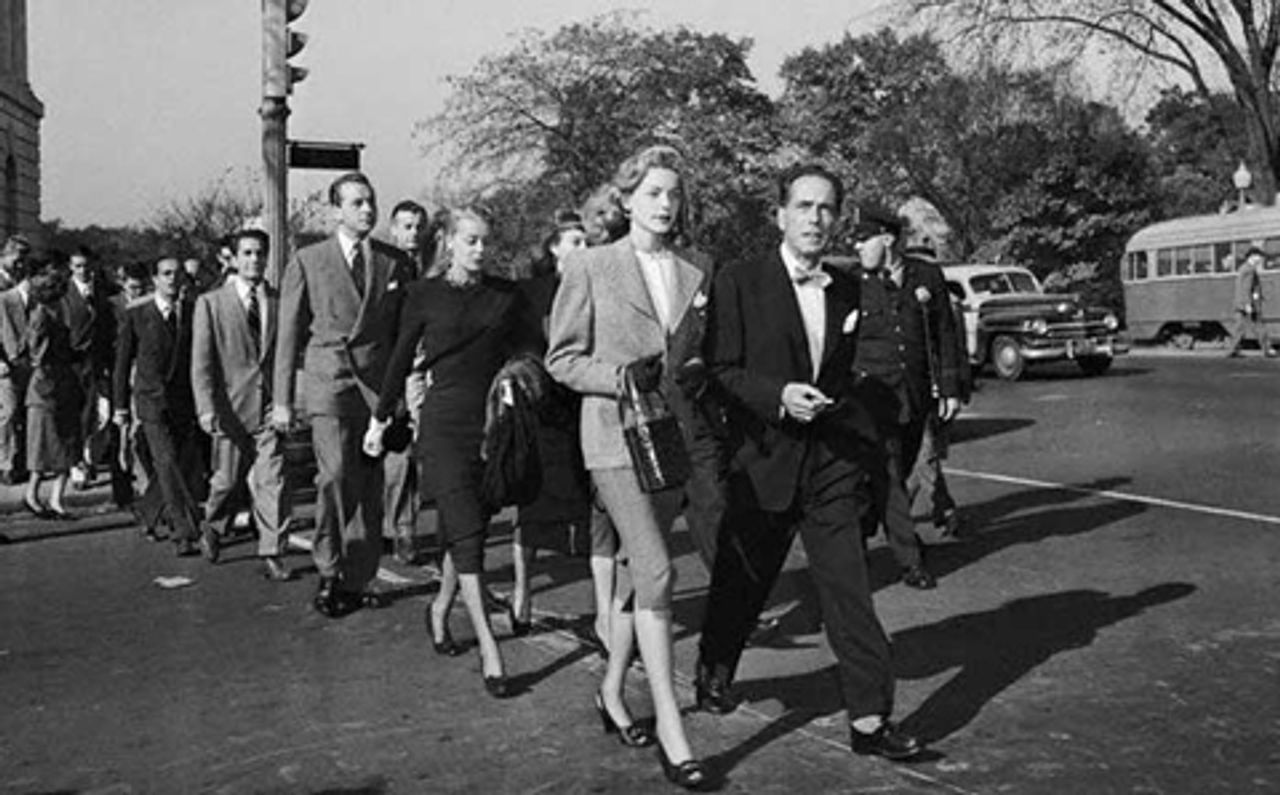
Huston later talks about how his Committee had to clear its own name, since obviously such a group could not be opposed to the HUAC without itself being suspected of Communism. Among others, Huston's group included Bogart and Bacall, as well as Edward G. Robinson, Burt Lancaster, Gene Kelly and Judy Garland. But eventually, the heat got too strong--particularly for the actors involved in the group. I highly doubt the public could have cared what the filmmakers thought of the HUAC hearings, but actors were another matter: audiences pay to see movies because of the actors. They usually care about what the actors think in real life. So, eventually, Bogart and Bacall were so stung by the criticism that they had to quit. They had to pack up their bags and go home. Huston was left to fight it alone, with his fellow filmmaking artists.
Among those filmmaking artists was Billy Wilder. My favorite of the stories Huston tells during this chapter of his book is the story of him and Wilder banding together and standing up for their beliefs, when nobody else would:
People were required to take oaths of allegiance in order to keep their jobs. This seemed to me both childish and insulting as well as an extremely dangerous precedent. Obviously, any Communist would take the oath immediately. At a general meeting of the Screen Directors Guild a Machiavellian character named Leo McCarey--an Irish director of sophisticated comedy--proposed that the question of whether to take the oath or not be decided by a show of hands, rather than by secret ballot, so that no one would dare oppose it. I looked on in amazement as everyone in the room except Billy Wilder and me raised their hands in an affirmative vote. Even Willy Wyler, who was sitting out of my sight, went along. Billy was sitting next to me, and he took his cue from my action. When the negative vote was called for, I raised my hand, and Billy hesitantly followed suit. I doubt if he knew why, but he could tell he was in deep trouble from the muted roar that followed. I am sure it was one of the bravest things that Billy, as a naturalized German, had ever done. There were 150 to 200 directors at this meeting, and here Billy and I sat alone with our hands raised in protest against the loyalty oath. I felt like turning over the table over on that bunch of assholes! It was a long time before I attended another Guild meeting, and when I did, it was a different story.
I would like to think that had I been working at the time, I would have done all of the things that Huston did... but I don't know for sure. Of Kazan, I don't so much blame him for naming names as much as I take issue with him refusing to apologize for it (Kazan writes in his own autobiography that he's not sorry for what he did and he then promptly tells his critics to go fuck themselves). It is likely that Huston was able to avoid the blacklist because of his powerful connections. Other actors and directors had no choice but to cave in, in order to save themselves. Huston talks movingly about how Sterling Hayden once named a personal friend of his, and then broke down over it years later when he learned that his friend ended up dying in jail.
I'm going to take a huge gamble here, though, and say something risky: many of Huston's films seem to flirt with Marxism. I know, it sounds stupid, but aren't many of his movies about de-establishment and venturing out to other habitats to find one's self? Though, I suppose some would instead deduce that Huston's "escapist" thematics are more in line with somebody like Thoreau: it's that urge to just break away from order and imperialism, and experience nature--or, if not nature, a Darwinian survival-of-the-fittest environment. We could even perhaps argue that Huston was one of the first independent filmmakers. He often got his way with the studios, and when he didn't, he simply left.
Who else but Huston would rebel against Warner Bros., with its banal studio backlots, and make The Treasure of the Sierra Madre way out in South America? Who else but Huston would make a movie like The African Queen because of the personal urge to get away from the imposing order of post-war America and plunge into the hostile basins of Africa, where he could be free to torture his actors all he wanted? Or make The Man Who Would Be King out in Morocco and (gulp) Afghanistan? That, too, was a story about rebels: Peachy and Danny don't want to rule a country so much as loot it (although Danny soon changes his mind, and decides he wants to be a democratic leader after all--maybe this is why he perishes, and Peachy is spared). And then there's The Misfits, Fat City and Wise Blood, in which Huston closes the door, and forces his Marxian rebels to deal with society as it really is. If I've veered off the tracks a little, please tell me... but I think I'm getting somewhere with all of this! ;)
In other chapters of his book, Huston switches gears and talks about other filmmakers he admires, including some of the foreign filmmakers who were working during his later years (Bergman, Fellini and Bunuel). So, there's another thing I share in common with Huston: a similar taste in cinema. Somehow, though, his politics stick more with me. There's a hilarious bit during the HUAC chapter in which Huston reveals how L.B. Mayer, somehow enamored with the witch-hunts and mistakenly thinking of McCarthy as an American savior, once told Huston that he believed McCarthy was one of the greatest men of their generation. Knowing Huston's track-record with impressive documentaries, he then asked Huston if he would like to head a doc that would be a tribute to McCarthy's efforts.
"'L.B., you're out of your God-damned mind'!" Huston responded. "I just laughed and walked away."
And THAT, ladies and gentleman, is Huston for you.


